Agriculture is central to livelihoods and food security in India, especially in Punjab, Haryana and western Uttar Pradesh. The Green Revolution led to the dominance of the rice–wheat cropping system. Punjab, known as India’s principal granary, plays a crucial role in national food production, contributing nearly one-fourth of India’s rice and over one-third of its wheat.
However, this system has reduced crop diversity and increased pressure on natural resources, generating large volumes of crop residue. The short gap between rice harvesting and wheat sowing forces farmers to clear fields quickly, often through stubble burning. With mechanization leaving behind heavy residue, about 14 million tons annually, is burned in Punjab alone, causing severe air pollution across North India, particularly in Delhi-NCR.
Stubble burning has long term consequences, including loss of soil nutrients, declining soil organic content and reduced soil fertility, water retention, and biodiversity. It also contributes to severe air quality deterioration and health risks.
To combat this, governments and research institutions have introduced alternatives like the Happy Seeder, balers and in-situ residue management, along with awareness campaigns promoting stubble as a resource.
Efforts toward crop diversification and millet cultivation aim to make agriculture more sustainable, yet high costs, limited machinery access, and insufficient financial incentives continue to slow adoption.
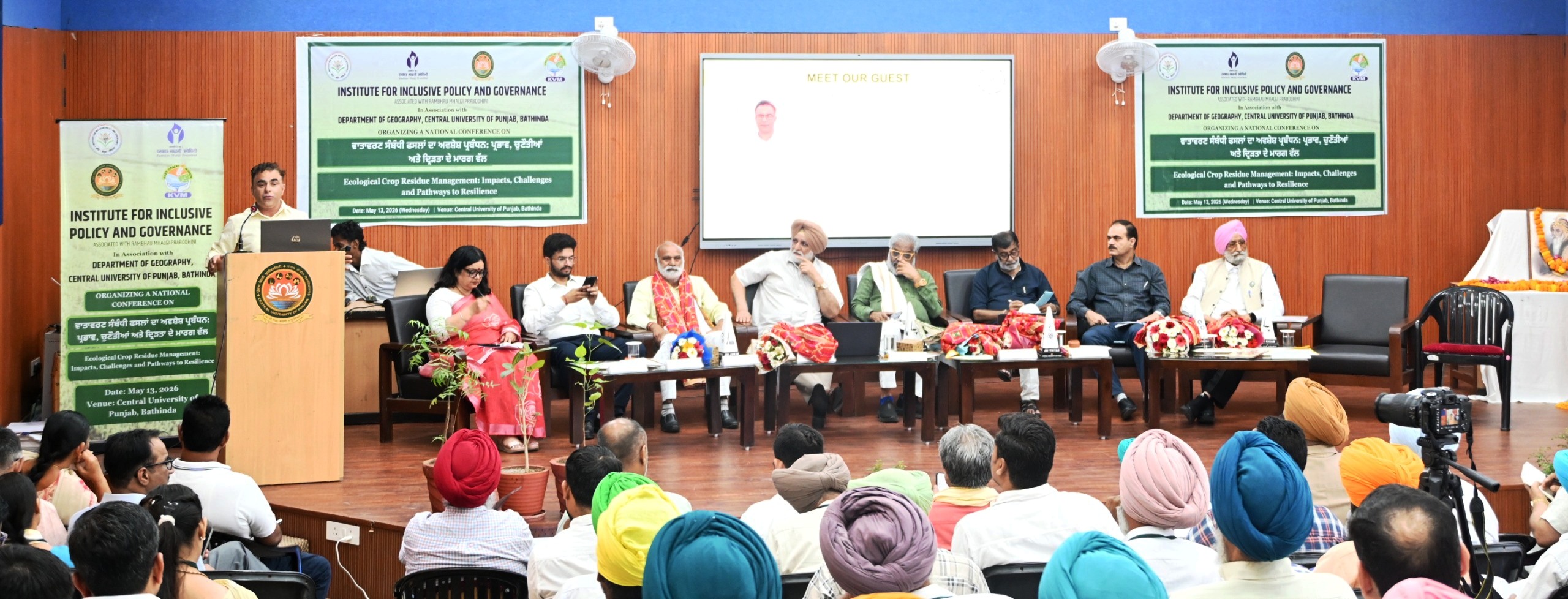
The conference aims to provide a platform for dialogue and collaboration among policymakers, researchers, environmental experts, civil society, and farmers to develop sustainable solutions for crop residue management.
It will focus on reducing stubble burning, promoting affordable and farmer-friendly technologies, and identifying policy pathways that ensure both agricultural productivity and environmental sustainability.
To assess the current status and challenges of crop residue management in Punjab and other rice–wheat systems of India.
To evaluate the environmental, economic, and health impacts of stubble burning at local, regional, and national levels.
To highlight farmers’ perspectives and challenges in adopting alternative residue management practices, ensuring that solutions are farmer-centric and socially inclusive.
To explore sustainable, practical, and farmer-friendly alternatives to crop residue burning.
To develop actionable recommendations and collaborative strategies for promoting sustainable agriculture in Punjab.
Status and Trends of Stubble Burning in Punjab
Agro-Economic & Institutional Drivers
Farmers’ Decision Making: Constraints, & Incentives
Policy, Governance & Institutional Frameworks
Schemes, Subsidies, Implementation Gaps
Public Health & Social Impacts
Environmental Sustainability
Crop Diversification & Technological Alternatives
Market Linkages & Biomass Utilisation
Awareness & Behavioural Change
Multi-Stakeholder Convergence & Pathways for Action
Patron
Vice Chancellor, Central University of Punjab
Co-Patron
President, IIPG
Organizing Secretary
Director, IIPG
Convener
Department of Geography, Central University of Punjab
Co-Convener
Asst. Prof., Department of Geography, Central University of Punjab
HOD, Department of Geography, Central University of Punjab
Professor, Department of Geography, Central University of Punjab
Asst. Prof., Department of Geography, Central University of Punjab
Asst. Prof., Department of Geography, Central University of Punjab
Asst. Prof., Department of Geography, Central University of Punjab
Asst. Prof., Dept of Geography, DAV College, Chandigarh
Asst. Prof., Department of Geography, Central University of Punjab
Executive Director, Kheti Virasat Mission
Vice-President, IIPG